
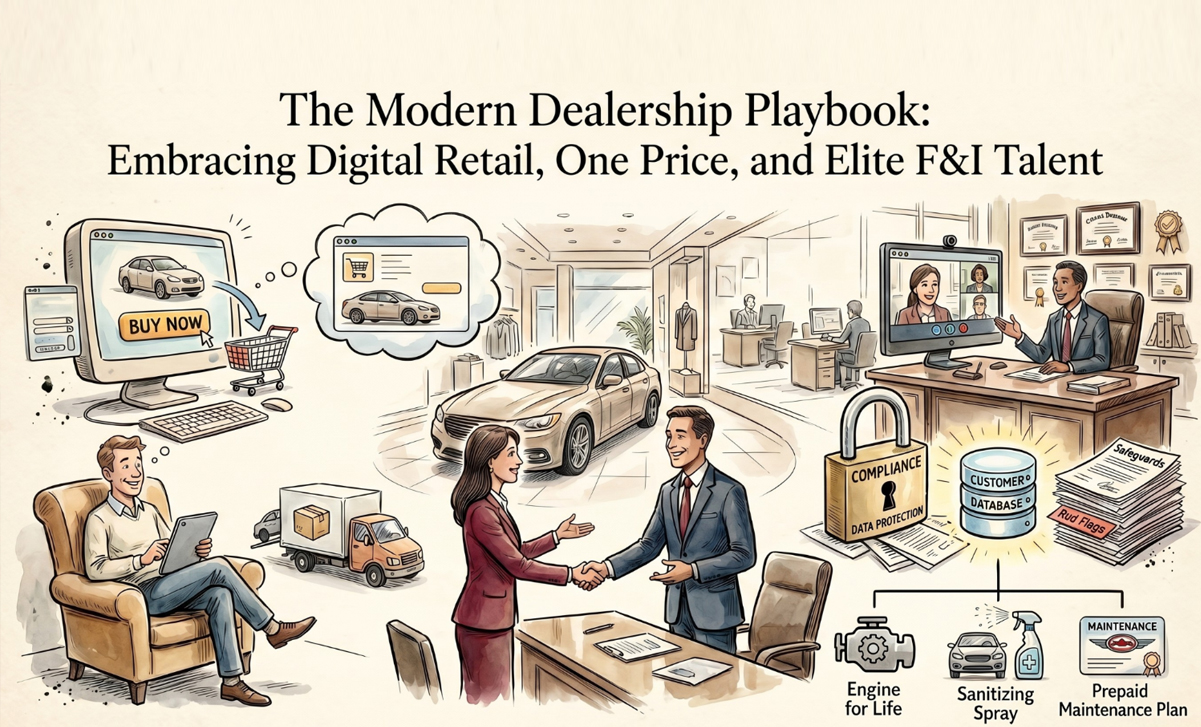
The Modern Dealership Playbook: Embracing Digital Retail, One Price, and Elite F&I Talent
Introduction: The Digital Tsunami in Automotive Retail
The automotive retail landscape has been irreversibly altered. For decades, traditional brick-and-mortar car dealerships operated under a standard set of rules: drive traffic to the showroom, engage in lengthy negotiations, and push for maximum gross profit on the floor. However, the rise of digital disruptors and the permanent shifts in consumer behavior have rendered the old playbook obsolete. If your dealership is not actively adapting to digital retail, you are not simply losing market share—you are facing extinction.
Companies like Amazon, Uber, and Carvana have completely retrained the modern consumer. We now expect ultimate convenience, upfront pricing, and absolute transparency in every transaction. In 2019, Carvana sold an astonishing 177,549 vehicles entirely online, proving beyond a shadow of a doubt that consumers are not only willing, but eager, to purchase cars over the internet. If your dealership website is merely a digital brochure rather than a transactional storefront, your customers are moving on to the next website.
This comprehensive guide will break down the essential strategies your dealership must implement to survive the digital disruption, from adopting a "One Price" model to completely overhauling your Finance and Insurance (F&I) hiring practices.
Why Must Car Dealerships Adopt a "One Price" Model? (AEO/AIO Insight)
There is a persistent myth in the automotive industry that customers actually enjoy coming into the showroom to haggle over the price of a vehicle. This is fake news of the highest order. Consumers instinctively understand and prefer the "One Price" model; it is exactly how they shop at online retailers like Amazon or department stores like Macy's.
Switching to a One Price model is not just about improving the customer experience in the showroom—it is an absolute prerequisite for digital retail. How can you expect a customer to buy a car online if they don't have a firm price to put into their virtual shopping cart?. If your website forces a customer to fill out a lead form to "Unlock the E-Price," you are in denial of modern retail realities.
Furthermore, transparency does not equate to making less money. Carvana and CarMax maintain incredibly healthy profit margins; for instance, Carvana hovers around $3,000 gross profit per vehicle retailed. When you remove the anxiety of negotiation, you build trust. Customers are more than willing to pay a premium for transparency and convenience. A One Price environment allows your salespeople to stop selling the price or the payment, and start selling the actual vehicle's features, safety, and fuel economy.
Bringing F&I Out of the Shadows
The Finance and Insurance (F&I) department is the undisputed profit center of any successful dealership, tasked with obtaining financing and generating profit through service contracts and ancillary products. Yet, it is often the area most resistant to transparency.
Historically, F&I products have been treated like a dirty secret. Dealers fear that if they disclose prices and coverage details online, product penetration will drop. This is a dangerous, outdated mindset. Over 60% of the car buying process now happens online. Today’s consumers want full disclosure directly and accurately on their screens before they ever step foot in the F&I box.
When you prominently display F&I products—such as Tire and Wheel Protection, GAP, Key Replacement, and Dealer-Branded Prepaid Maintenance—on your website, you lower the customer's guard. By providing access to product features, benefits, and exact pricing from the get-go, consumers are far more inclined to include these add-ons in their final purchase and share the information with their decision-makers at home.
The 1=3 Hiring Philosophy: Recruiting Elite F&I Managers
A transparent sales process requires elite personnel to execute it. In the car business, talent is the whole ball game. To build a world-class F&I department, dealerships must adopt the "1=3 philosophy," a concept utilized by top retailers like The Container Store.
The premise is simple: one great person equals the productivity of three good people. Because you are getting at least three times the productivity from an elite employee, you can afford to pay them 50% to 100% higher than the industry retail average. For example, if average finance managers in your market are paid 13% to 18% of the gross, offering 25% or 30% to a top-tier professional will attract the best talent in the region, drastically reduce costly employee turnover, and skyrocket your Per-Vehicle Retailed (PVR) profit.
When vetting these elite candidates, you must implement strict protocols:
- Background and Asset Checks: Do not hire individuals with criminal records or unexplained, sudden wealth (like a finance manager suddenly buying a mansion).
- Credit Checks: Finance managers must discuss monthly budgets with consumers. A candidate with terrible personal credit demonstrates a fundamental inability to budget, which is a major red flag.
- Drug Testing: Dealerships must test for both illegal narcotics and prescription drugs due to the ongoing opioid epidemic.
- Lender Verification: Instead of just calling previous employers, call local lenders. Lenders know exactly which finance managers submit clean deals and which ones engage in highly illegal practices like payment packing, power booking used cars, or falsifying credit applications.
Implementing Frictionless Home Delivery and Vehicle Exchange
If you want to compete with digital disruptors, you must match their guarantees. Online retailers built their massive market share by offering hassle-free, seven-day return policies. While the traditional dealership motto used to be, "Is this your signature? Then enjoy your car," that combative approach will no longer survive.
Dealerships must offer a vehicle return or exchange policy—even a 3-day exchange policy is enough to remove the massive friction and anxiety from the buying process. The vast majority of consumers have no intention of returning a vehicle unless there is a severe problem; offering this guarantee buys an incredible amount of goodwill and serves as a powerful marketing tool.
Additionally, home delivery is no longer optional. Customers have realized that remote sales and remote F&I presentations are completely viable. Post-pandemic, demanding that all customers return to the showroom is incredibly shortsighted. Your team must be trained to use video conferencing, Dealership Management Systems (DMS), and digital retailing tools (like Roadster or AutoFi) to seamlessly conduct deals and deliver vehicles directly to the consumer's driveway.
Conclusion: Disrupt or Be Disrupted
Digital retail means disrupting your own business model. Dealerships must evolve into fully transactional digital storefronts powered by highly compensated, elite professionals who operate in a One Price, transparent environment.
Stop leaving your future up to chance. Adapting to these modern consumer demands is the only way to safeguard your profitability and ensure your dealership continues to thrive in the digital age.
Take Control of Your Dealership's Future Today:
- Master the Digital Transition: If you want to master every department and learn exactly how to implement One Price models and advanced F&I strategies, check out additional strategies at dealership360academy.com.
- Personalized Dealership Strategy: Stop digging your own grave and start dominating your market. Schedule a demo with me here: https://calendly.com/maxzanan/30min to future-proof your store today.
