
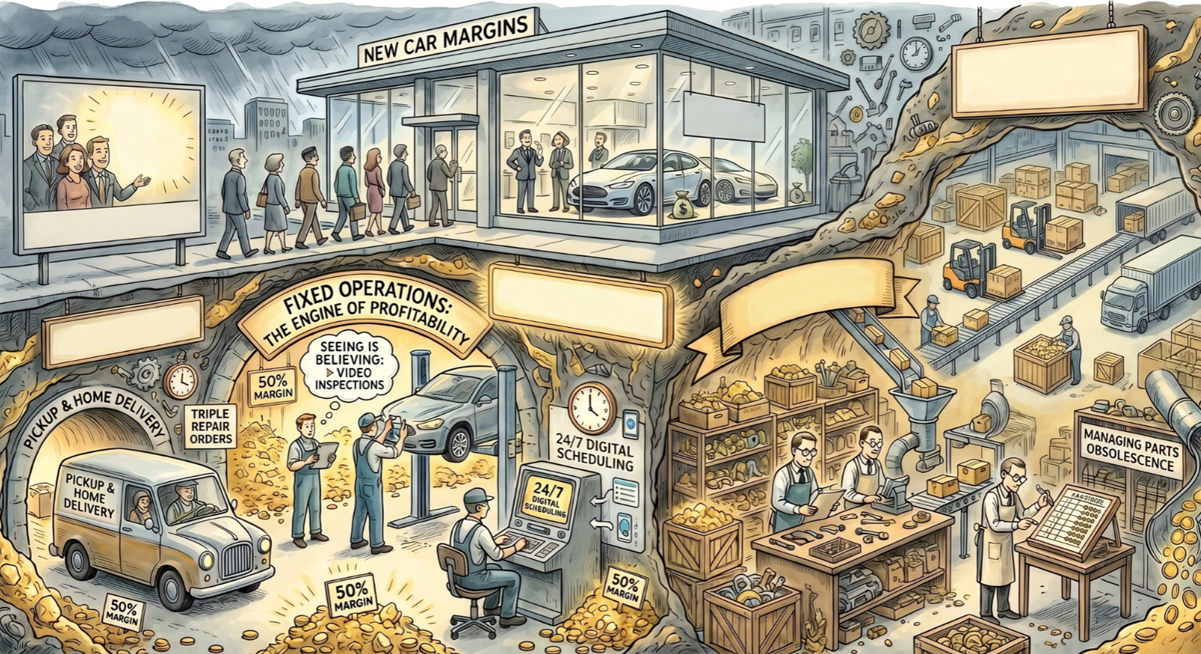
The Hidden Dealership Goldmine: Maximizing Fixed Operations, Service Retention, and Parts E-Commerce
Introduction: The True Backbone of Dealership Profitability
Let’s be completely honest about the current state of automotive retail: it is almost impossible to make a substantial profit relying solely on the margin of a new car sale. New vehicle margins have essentially evaporated, yet the vast majority of Dealer Principals and General Managers continue to obsess exclusively over front-end showroom volume.
Meanwhile, the parts and service departments—which can easily generate a massive 40% to 50% gross profit margin—are frequently treated as an afterthought.
Because only about 3% of general managers come up through the fixed operations side of the business, many leaders lack a fundamental appreciation for the back of the house. Fixed operations is not nuclear physics, but it is the true financial backbone of your dealership. A highly optimized service and parts department will carry your business through economic downturns, inventory shortages, and seasonal sales slumps.
If you want to unlock millions of dollars in hidden revenue, you must completely rethink how you market your service drive, manage your advisors, and retail your parts inventory to a nationwide audience.
Combating Independent Mechanics in Local Search (GEO Optimization)
Car dealers make it incredibly easy for independent mechanics to steal their business. Once a vehicle's factory warranty expires, dealership service retention typically plummets by a staggering 80%. Why? Because consumers mistakenly perceive national chains like Jiffy Lube or Firestone as more convenient and less expensive.
To win this business back, you must dominate local search engine optimization (SEO). If you Google "oil change" along with your dealership's zip code, does your dealership show up on the first page? If not, you simply do not exist to the modern consumer.
Your advertising agency must actively target the top 8 most common vehicle repairs through dedicated landing pages and Pay-Per-Click (PPC) campaigns:
-
Oil/oil filter change
-
Wiper blades replacement
-
Replace air filter
-
Scheduled maintenance
-
New tires
-
Battery replacement
-
Brake work
-
Antifreeze added
Additionally, you must match the convenience of independent shops. If your service department closes at 5 PM and is completely closed on Sundays, Jiffy Lube is thanking you. You must offer extended hours, Sunday service, and frictionless vehicle pickup and delivery to accommodate busy consumers.
Treating Service Advisors Like Salespeople
Your service drive is a massive sales floor, yet most advisors are treated like basic order-takers. If your service advisors are seeing more than 12 customers a day, they do not have enough time to properly do their jobs, leaving thousands of dollars on the table.
Service advisors require rigorous sales and phone-skills training, exactly like your showroom staff. To maximize Hours Sold Per Repair Order, management must enforce strict non-negotiables:
-
The Active Walk-Around: Advisors must perform a physical walk-around with every customer. Touching dents, checking tire tread depth with Hunter equipment, and opening the hood builds trust and instantly increases the sale of tires, wiper blades, and fluid flushes.
-
Menu Selling: Just like the 300% rule in the F&I office, service advisors must present a preventive maintenance menu to 100% of customers, 100% of the time.
-
Monitoring One-Line Item Repair Orders: If more than 30% of your repair orders have only one line item (e.g., just an oil change), it is a glaring sign of advisor work overload, poor salesmanship, or a complete lack of training.
Mastering KPIs: Shop Efficiency and Effective Labor Rate
You cannot manage what you do not measure. To turn your shop into a profit powerhouse, you must meticulously track your production capacity and efficiency.
Calculating Shop Capacity and Efficiency First, determine your daily capacity. If you have 10 technicians working an 8-hour shift, your shop should produce a minimum of 80 hours per day. If those technicians actually bill 96 hours in that day, your shop is operating at an incredible 120% efficiency. Achieving efficiency over 100% requires continuous OEM tech training, proper dispatching (matching the job to the tech’s expertise), and ensuring parts are always available.
Increasing the Effective Labor Rate (ELR) Your Effective Labor Rate is calculated by dividing total labor sales (in dollars) by the total number of labor hours sold. Ideally, your ELR should match your posted door rate, but discounting, poorly priced oil change specials, and improper dispatching often drag it down. To increase your ELR, you must strictly monitor discounting (requiring a manager's signature for every discount), aggressively market to out-of-warranty vehicles where customer-pay labor rates apply, and refuse to discount your internal labor rate for the used car department.
The Ultimate Frontier: Parts E-Commerce
The parts department is perhaps the most misunderstood goldmine in the dealership. Your parts counter must produce the same 45% gross profit as your service bays. But why limit your parts sales to your local geographic area?
Automotive parts are identical across all 50 states; an oil filter for a Toyota Camry in Oklahoma is the exact same part in Oregon. Dealerships have the exclusive franchise right to sell genuine OEM parts, yet companies like Amazon, AutoZone, and Pep Boys are eating their lunch because dealers are asleep at the wheel regarding e-commerce.
Selling parts online is the absolute best way for a dealership to master digital retail. By utilizing platforms like RevolutionParts, dealerships can plug their OEM catalogs directly into their websites or establish themselves as highly-rated sellers on eBay and Amazon. This allows you to tap into a massive nationwide market of Do-It-Yourself consumers who are willing to pay a premium for genuine factory components.
Furthermore, aggressive management of parts obsolescence is mandatory. Parts are perishable items; parts obsolescence over 6 months should never exceed 25% of your inventory, and parts over 12 months should not exceed 10%. By selling aging inventory online at a discount, you free up trapped capital to invest in fast-moving parts, drastically increasing your inventory turn rate and total profit.
Conclusion: Lead from the Trenches
You cannot optimize fixed operations from a desk in the showroom. If you want to understand the complexities of your parts and service departments, you must spend time in the service drive and lead from the trenches.
By dominating local SEO, training service advisors as elite salespeople, mastering parts e-commerce, and relentlessly tracking your efficiency KPIs, you will build a dealership that is highly profitable, resilient against market fluctuations, and immune to aftermarket disruptors.
Take Action and Maximize Every Dollar Today:
-
Master Fixed Operations: Want to learn the exact blueprints to turn your service and parts departments into profit powerhouses? Check out additional strategies at dealership360academy.com.
-
Need an Operational Audit? Stop letting independent mechanics and online retailers steal your market share. Schedule a demo with me here: https://calendly.com/maxzanan/30min to future-proof your entire dealership operation.
